


 0 comments
 0 views
-
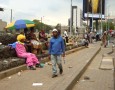
- Waiting for a taxi, Bree rank, Newtown

-
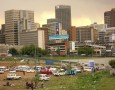
- Taxi drivers gathering, Newtown

-

- Sandton skyline in distance

-
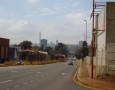
- Rea Vaya, Auckland Park

-

- Nelson Mandela Bridge, Newtown

-

- Joburg Railway Station, Joubert Park

-
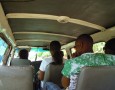
- Inside a shared taxi

-

- Fast and far, the Gautrain

-

- Dusk over railroad, Newtown

“If you are in a hurry, then I’m not: don’t rush me”. What can be seen as a funny suggestion, written in the interior of a shared taxi in Johannesburg, is more than just a joke. Especially if compared to another sentence, the one advertising, along the highways, the newest Gautrain: “If you can read this, you are going too slow”.
The plethora of public transport in Johannesburg might sometimes seem to be an indicator of the insurmountable cleavage that divides the city in two. “I’ve never been on the Gautrain. – explains an inhabitant of Northcliff – It is only suited for white, rich businessmen”. Just a few kilometers North, in Randburg CBD or in Sandton, the concern is instead about the shared taxis: “It isn’t safe to take them,” someone says, “especially at night. I’d rather avoid them”.
The prominent gap between the metro-rail users and the taxi, or Metrobus users, is not just economic, nor it is just geographical (with regard to the clear distinction between the North-South axis, linking Johannesburg downtown to Sandton and Pretoria, and the East-West axis, where the most populated residential areas stay, kept together and at the same time divided by the railroad line). This distinction, in fact, comes from two different mentalities, two different cultures coexisting in Johannesburg.
For the world of finance, “fast and far” is a must for success. For the micro-economy that pulsates in the city centre and in suburbs or townships like Eastcliff, Soweto and Alexandra, the keywords are different. There, the local aspect is predominat: “I buy vegetables and fruits here in town instead of going to supermarkets,” says a customer in a street market, “because here I can find fresh products, directly coming from the fields”.
It’s in such local environments, surrounded by loud music, where a strong sense of community can grow. The same can be said for transport. While the Gautrain may foster privacy and individuality, the wheel transports are a better basis for everyday social interactions.
The world may rush in Johannesburg, “a world-class African city”, as the administrative adverts state; but the city’s micro-economy and micro-society is still the heart of the network of relations in most of the areas, where a crowded shared taxi might not be the fastest transport, but it will still bring people anywhere.
Understanding the difference between those two realities and speeds is a must in South Africa. Working on a connection between them, and creating a more efficient and integrative public transport network would mean being able to use the strengths of both realities, helping Johannesburg face the tasks of modernity without forgetting its African heritage, in a powerful and open-minded mixture of global and local markets, society and culture.